
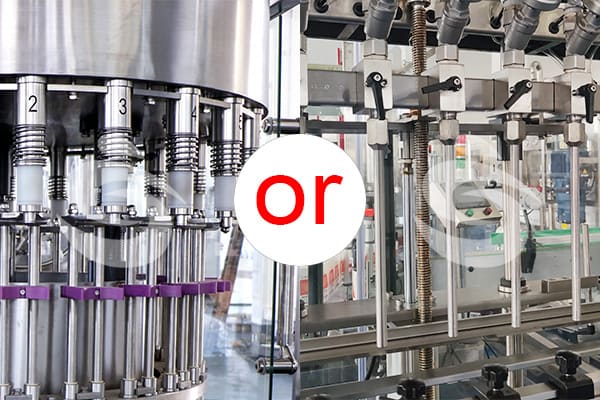
Before we begin to look at the details, let’s set the scene a little. Whether you’re upgrading an existing production line or planning a brand-new setup, understanding the difference between Rotary Pump Filling Machine and other automatic systems matters—a lot. These choices affect your efficiency, running speed, cost per bottle, and even how flexible your plant will be in the future.
Table of Contents
When Should You Compare Rotary vs. Linear Systems?
What sets rotary systems apart from any other automatic machine?
Why would companies select either rotary or linear solutions?
How Do Rotary and Linear Machines Perform in Real Applications?
Comparison Table: Rotary vs. Linear
Q&A Section
When to Compare Rotary vs. Linear Systems
You should begin to consider these systems when your production exceeds small-batch or semi-automatic operations. Once your output needs become steady, faster, and more precise, the time will come when you need to make a choice between a Rotary Pump Filling Machine (rotary system) and a Linear Filling Machine (straight-line system).
If you are producing beverages, chemicals, daily-use liquids, condiments, or even thick products, this comparison becomes very important. And yes, whether a Plastic Bottle Filling Machine or a Glass Bottle Filling Machine is used, the choice impacts performance differently.
What Makes Rotary Systems Different from Other Automatic Machines?
Rotary machines work in a continuous, circular motion. Bottles move continuously around a carousel—no stopping and restarting. This single design difference leads to multiple performance advantages:
- Much higher filling speed
- Stable bottle handling
- Better synchronization
- Lower vibration and less product spillage
Contrarily to this is the Linear Filling Machine, at which the products move along a straight line. Bottles travel station to station, pausing at each unit: filling, capping, labeling, etc. Such design allows more flexibility but usually at lower speeds.
Here’s the thing: rotary machines thrive in high-throughput environments, while linear systems help businesses seeking adjustable formats, smaller batches, or lower investment.
Why Do Companies Choose Rotary or Linear Solutions?
Choosing between them usually comes down to five core factors: speed, space, flexibility, cost, and product type.
Speed & Throughput
If your production goal is 10,000–40,000 BPH and stability is key, the clear winner would have to be a Rotary Pump Filling Machine. Linear Machines operate in a start-stop pattern and simply cannot produce at that rate.
Flexibility
A Linear Filling Machine is easier to adjust, making it more suitable for companies running different product types, bottle shapes, or small-batch seasonal beverages.
Bottle Material
The systems work with both Plastic Bottle Filling Machine setups and Glass Bottle Filling Machine lines, but rotary is preferred in the case of fragile containers because of smoother handling.
Budget
Rotary systems are more expensive up front and to maintain, but they provide a much lower cost per bottle as time goes on, owing to faster throughput.
Available Space
Rotary lines need compact, circular footprints; linear lines need longer production space.
How do rotary and linear machines perform in real applications?
Let’s make it practical. Suppose you need to fill juice, water, beer, carbonated drinks, or daily chemicals:
- Using a plastic bottle filling machine? Rotary is great for PET bottles in water and CSD lines.
- Using a glass bottle filling machine? Rotary prevents impacts and reduces breakage.
- Running thick sauces or cosmetics? For those, linear could be a better option as it’s easier to clean and adjust for viscosity.
And yes, real-world customers do combine both: rotary for mainstream products, linear for specialty SKUs.
Comparison Table: Rotary vs. Linear
| Feature | Rotary Pump Filling Machine | Linear Filling Machine |
|---|---|---|
| Speed | Very high, continuous motion | Medium, start-stop |
| Flexibility | Lower | Higher |
| Footprint | Compact, round design | Long straight layout |
| Bottle Types | Excellent for PET & glass | Good for varied shapes |
| Accuracy | High due to stable motion | Depends on stop-fill timing |
| Investment | Higher | Lower |
| Best For | Mass production | Multi-SKU production |
What really makes rotary systems different from other automatic machines? It’s the continuous, smooth, circular motion that brings unequalled output and efficiency. Meanwhile, linear systems shine when flexibility and cost control matter more than extreme speed.
Whether you’re choosing between a rotary pump filling machine, a linear filling machine, a plastic bottle filling machine, or a glass bottle filling machine, the best decision comes down to matching your production style, your growth plan, and the markets you serve.
Q&A Section
Q1: Are rotary machines always faster than linear ones?
Usually, yes. Rotary machines offer continuous movement, greatly increasing speed.
Q2: Which machine is more suitable for many bottle sizes?
Linear filling machine is usually more flexible for multi-SKU production.
Q3: Can both machines fill plastic and glass bottles?
Absolutely, both systems work with plastic bottle filling machine and glass bottle filling machine configurations.
Q4: Is it worth investing more in a rotary pump filling machine?
If you need high output and long-term cost efficiency, then yes-rotary delivers better ROI.
Q5: Which system is easier to maintain?
Linear machines are simpler and cheaper to maintain, since the design is less complex.